We may see communication as vital for everyday functioning, but do we have the slightest notion of the underlying process?
What are Communication and the communicative process?
Many theorists have defined communication throughout the years but for the sake of clarity, we’ll use the definition proposed by Miller (1966). According to him, it has as its central interest those behavioral situations in which a source transmits a message to receiver(s) with conscious intent to affect the latter’s behavior.
According to the book Human Communication (2006), there are 6 stages within the communicative process.
- Naturally, any communicative act begins with a sender who decides to initiate a message which expresses a specific set of intended meanings.
- The sender encodes or creates the intended meanings by selecting specific words and gestures which have conventional meanings presumed to be understood by the receiver
- The message is transmitted; this message may be spoken or written so as to cross the space between the sender and receiver as a signal of patterned information.
- The receiver perceives the incoming patterned information, identifying it as a specific language.
- The receiver then decodes or interprets the message by constructing his/her own understanding of the conventionalized meanings of the symbols
- The mere fact that the receiver is interpreting the message; he or she will be influenced in some way which can range from trivial to profound.
Here is a visual representation of the process
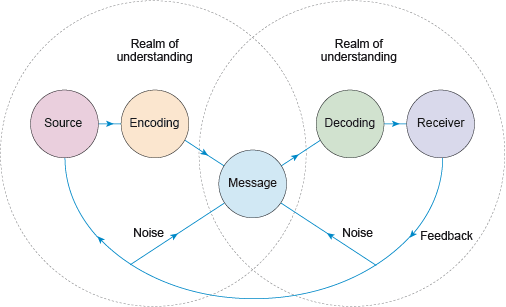
It is worth mentioning that this model is basic; it assumes that during an interaction the roles are static and there aren’t any interferences. FAR FROM THE TRUTH. During an interaction the sender and the receiver may switch roles frequently and the transmission of the message may be affected by environmental factors such as noise in the physical environment or anything psychological such as perceptions.
But how do we know if our messages are being received or interpreted accurately?FEEDBACK. This allows us to know whether we are getting through to someone. Feedback may be verbal or nonverbal. For instance, if I am talking to my lecturer and she begins to frown or shrug her shoulders, I know that it is highly probable that she doesn’t understand me. This cue prompts us to change or restructure our messages
Now, let’s turn our attention to another way in which meanings may be produced.
Representation

I bet you weren’t aware that the word represent can actually have 3 different meanings.
- To stand for, as in the case of a country’s flag which when flown at any international event, signals the country’s presence at that event
- To speak on behalf of, like a spokesperson. Take the pope for instance, it can be said that he represents the Roman Catholic community
- The third takes the sense of presenting a historical fact in a contemporary time. As such represent is seen as RE- present.
Representations are only meaningful within discourse; that being statements, images, practices and institutions which represent a body of knowledge. This is because these represent a set of shared conventions based on a common experience. For example, representations of mother and child in western art, advertising and newspapers usually portray women as nurturers. This is one element of the system of representation that constructs women primarily as mothers. The message here is that a woman’s worth is tied to her motherly qualities.
It must be noted that they are purposefully constructed often for exploitative purposes and power. We see this with the Europeans back in the days of slavery. In order for one area of the world to colonise another, the colonisers must represent the world in a particular way. The British imperialists understood Africa to be an uncivilised place, filled with primitive people. Whereas Europe represented enlightenment and reason; this knowledge endorsed the practice of slavery.
As I’m sure you all can see now how meanings can be manipulated as well as misinterpreted. What may conjure one image to you may conjure another image for another. In spite of different individual perspectives, there are still experiences which may unite us based on commonality. These representations are less likely to change.
 Chris opines