The importance of language in the Caribbean

What is a language? A layperson may say “a form of communication which uses words.” However, we’ll defer to the linguists for now. According to Bloch and Trager (1942), a language is a system of arbitrary vocal symbols by means of which a social group cooperates. So now that we’ve established what language is, I think it’s apt to highlight what influences our choice of language.

Photo credit- Google Images
  • Social setting

If I am amongst my friends, I’ll use my vernacular of ‘Bajan’ but if I am doing a presentation before my colleagues and boss, I certainly will be using Standard English.

  • Media

What we consume influences our behaviour. Have you ever heard your friend say “ ain’t nobody got time for that” or better yet have you found yourself using “man” as an interjection whenever you speak?  If your answer is yes then it is 99.9% probable that these are products of pop culture.

  • Education/knowledge

When we go to school, we are taught a standard language which has prestige and universal appeal which will give us the ability to obtain lucrative jobs. With this knowledge, we sometimes disregard our vernaculars because we know how differently a person speaking a standard language is perceived from one who speaks a nonstandard language.

There are several English varieties in the Caribbean today which are spoken and these have strong historical connotations.  

  • Foreign English
  • Radio and television English
  • Erudite English
  • Colloquial English
  • Creole English
  • Rasta English
  • Profane English
photo credit- google images

These are stereotypes and the order in which they appear may represent the status of each. Foreign English largely refers to English spoken by the British, Americans and Canadians. I know that you have an idea of what the reference here is. Yes Tourism, which is one of the main foreign exchange earners for the region. If I were to go down to the Bridgetown port and observe the taxi driver’s interaction with the tourist, I would most likely readily observe how they modify their language in an attempt to impress tourists. The importance of tourism as an industry has encouraged locals to speak more like the visitors. Standard English is used to market as it is relatively cheap and represents sophistication and intelligence which in the Caribbean is associated with Standard English. Sometimes, there are persons who speak English so well that it makes you go, wow. These individuals are usually very adept at using idioms. This is known as Erudite English but note carefully it is not necessarily Standard English which is being used.

Photo credit- google images

What we say on a daily basis in informal contexts may be referred to as our colloquial English. However, there is no clear distinction between colloquial and creole English. What makes the distinction is acceptability. This means there are some things we use informally but that are not permitted in our Creoles. That’s right I and I say so. I am sure you know who I am, yip I am a Rasta. Rastafarians use I and I to express the concept of oneness of the mind, body and soul. Identity is always being reinforced and language is one of the fundamental means through which it is expressed.

Yh but wha d frig that got to do wid me? Such language is obscene and is territory specific. For example, in Jamaica even an innocent word such as parts can be used obscenely. As bad as profanity is, it reinforces bonds. I certainly use swear words around my friends in a comical way but not to offend them. I welcome it.

As you all should conclude language really has significance, it fits with our purpose, audience and our personality. These different English varieties only serve to demonstrate how hierarchical Caribbean society is but also how language may be used to sustain human relationships.

Computer mediated technology’s impact on Caribbean Culture

Email, chat rooms, online forums, social media, what do all these have in common? They are all forms of communication and technology known broadly as computer mediated communication. There are two forms of computer mediated communication; synchronous and asynchronous. The former refers to communication in real time; both parties are engaged in the communication simultaneously. However, they need not be in the same location. Examples include video chats or FaceTime audio calls. Conversely, the latter refers to communication whereby the sender does not receive an immediate response from the receiver. Examples include email and text messages.

photo credit- Google Images

Link between computer mediated communication and culture

As we already know technology facilitates the transnational flow of people, ideas and values and as a result radical changes have taken place. Culture is one element which has undergone significant changes due to technology. It changes the way we communicate as we have many more options now. Prior to the communication technology, we were obligated to carry out more face to face interactions as this was one of the only means by which George would be able to talk with Susanne. Nowadays, George may WhatsApp, Instagram or even Twitter dm Susanne among other means. The problem with these advancements is that they interfere with natural human interaction and shortly we’ll see more ways in which these advancements are changing Caribbean culture

photo credit- Google Images

Language

Many of the slang terms used in America are used today in the Caribbean colloquially and have become a part of our culture. Terms like cool, dude and awesome have made their way into our vocabulary through social media platforms like Twitter or Instagram. Why is that? Well we never want to be unaware of what’s trending, so we gravitate to these social media to find out about Nipsey Hussle’s funeral or Soulja boy’s hilarious comments on Drake. In the process we don’t even realise how much impact it is having on us until we find ourselves repeating something someone said to us with stress on the last syllable like Soulja Boy did when addressing Drake.

Festivals/Celebrations

Now, a few days ago I was alarmed by my friends on Whatsapp posting pictures with their siblings. I was alarmed because I actually had no clue what national sibling day was. The way my friends who are all Caribbean by the way, were celebrating this almost made me think it was Caribbean. Of course it isn’t, upon research I found out it was federally recognized in the US. Moreover, Halloween and Black Friday are celebrated in some parts of the Caribbean. Once again, are these Caribbean? Absolutely not! But the upcoming youth may believe so due to their high impressionability. What computer mediated communication has done is accelerate the process of cultural imperialism and if we are not careful we’ll be transformed completely and our indigenous traditions will be lost and by extension our identity.

I am an advocate of adaptation but not one of being a sheep. We must never follow the outside world at the expense of losing who we are.

Advertising: objectives and techniques

I’m sure you see ads every day, whether they be for cosmetics, clothes or even food the goals are universal. Before we delve into the goals of advertising, let us first establish what is advertising

Definition

Advertising involves communicating a message about goods and services to a customer. This message may be broadcast through a variety of media including television, radio, online or even print. This is very important as it not only sensitises persons but through advertising rapports may be established.

photo credit- Google images

Objectives

Generally advertisements are aimed at informing, persuading and reminding. The ad first tells us who is the entity and then what it has to offer. It then motivates us to use the product or service by detailing how beneficial it would be to our life. Once we are made aware of the company, product or service as well as its benefits, what is left to do? Well reinforcement is used through special emphasis on aspects such as the benefits. After all, the more we are told something, the more likely it is to stick with us.

photo credit- Google images

Common Techniques of advertising

Repetition- this helps the customer to remember as it is proven as a technique to improve memory. Think about it carefully, when we are studying for an exam, we repeat concepts as a study method. This certainly helps the vast majority of us and it works the same when something is constantly repeated to us.

Slogan- acatchy concise way to associate the product with an idea. These can be used to help viewers remember the main point about the product.

Bandwagon- everybody and their grandmother is doing it. Consequently, we feel left out. This is an appeal to our desire to fit in

Cause and effect- a problem is presented and the product or service is claimed to resolve the problem. Sometimes viewers do not even know they had the problem until they saw the ad.

photo credit- Google images

Application to the Caribbean

Let’s see how these techniques are manifested when the Caribbean is advertised to an international audience. Well first of all the traditional “sun, sea and sand” may constitute a slogan as this is what the Caribbean is associated with. The Caribbean has a tropical climate which means it is warm pretty much all year round unlike some countries abroad. There is also the appeal to the bandwagon through showcasing cruise lines. Cruises are one of the more popular means by which tourists visit the Caribbean and it gives them the convenience of visiting a variety of islands one after the other as a package. The constant showcasing of cruise liners not only gives the impression that  these are done by everyone but that it may also be the best way to see the Caribbean.

Moreover, the tranquility of the Caribbean is at the forefront of most adverts as the goal is to show tourists that it is the perfect place to unwind and escape the international hustle and bustle. These messages that we broadcast are important because after all tourism has been and will continue to be one of the region’s greatest foreign exchange earners.

Music as a means of representing Caribbean people

The million dollar question isn’t what is music? Because I am pretty sure everyone has an idea of what that is even if deriving a definition poses difficulty. However, what is Caribbean music? That’s a very good question and we’ll try to answer it.

Caribbean music

Caribbean music may refer to musical forms indigenous to the Caribbean such as calypso, dancehall or reggae. 9 times out of 10 when one thinks of Caribbean music, the first thing which comes to mind is reggae. However, these very musical forms have roots in mixture of cultural elements of different regions. For instance, the musical genre of ska, which preceded reggae and also originated in Jamaica, came to be through the fusion of African music, American blues and jazz. Thus, it may be said that Caribbean music may be characterised by a mixture of art forms from those present within the colonial years. Music was and continues to be a powerful tool for Caribbean people and we are about to see how.

photo credit- Google Images


Representation

Reggae emerged in the 1960’s during the political unrest. Music was an avenue by which Jamaica’s youth vented their frustration. This musical genre is associated with the Rastafarian movement. Thus through reggae lyrics, Rastafarians were able to voice their dissatisfaction with the political and social situation not only in Jamaica but also the Caribbean and internationally. According to Balter in his study “Seeking the Key to Music,” music facilitates a sense of belonging among a community of people. This means that Reggae became known as a musical form which told the story of Jamaicans’ everyday lives and thus fostered a collective identity.

Steel pan is s a musical form which emerged from a necessity to overcome oppression. The steel pan is significant because it is a symbol of innovation and resistance. Drums have always been integral to African rituals in the 1930’s so when cloth and bamboo were banned by the Trinidadian government, the people on the island who were impoverished beat steel oil drums to play their traditional rhythms.  This beating of steel oil drums became very popular by the 1940’s and through this the steel pan emerged. Therefore, the steel pan itself represents Trinidadians’ early struggles and can be said to a product of oppression.

photo credit- Google Images

One musical form which is heavily based on African culture is calypso. It is worth noting that this music genre developed in similar fashion to blues in the United States. It originated as slave songs sung by plantation workers who were not allowed to speak to one another, in order to communicate. This is another musical form born out of oppression. Calypso is powerful for Caribbean people because it is very political as it combines joyful cadences with serious and often subtle social commentary. Therefore, Calypso is a means by which Caribbean people not only reflect on the past and the present but it serves as pleas for social or political reform.

Conclusion

As we can clearly see music reflects our feelings, opinions and early struggles as a people. Every beat has significance, every lyric is important because music is just one of the many ways to tell a story.

All things Caribbean

We may call this one an amalgamation blog. Over the last few weeks or months rather, we’ve been discussing various concepts and how they relate to the Caribbean. Now we’ll combine them and see what we are able to come up with.

Photo credit- Google Images

The Caribbean is a region which consists of plurality and diversity and this is due to the different colonial powers that were present as well as the mixing between different ethnic groups during times of slavery. This is one of the reasons why there is so much controversy surrounding a single identity because how can there possibly be a single Caribbean identity when there is so much diversity sometimes even within a single territory. However, there still remain common grounds on which the Caribbean may be identified as one and that is a common historical experience of slavery and an adoption of the plantation society model such as the whites being traditionally at the top of the social ladder who possess the means of production and political power.

What also exemplifies diversity but is linked with identity is culture. This is expressed most notably through language; the use of various creole languages as well as local vernaculars. Creole languages are so integral to the Caribbean because many of them emerged as a result of contact between the colonisers and the colonised (Europeans and Africans). Do you know what this means? Slavery yes creole languages were born in slavery and what is one of the common grounds on which the Caribbean may be viewed as a single entity? A common historical legacy of slavery.

Therefore, creole languages may be said to be indicative of Caribbean identity and culture. Unfortunately, these very same creole languages are being changed as a result of global and social pressures. A process known as decreolisation is taking effect and it refers to when a creole loses its creole features and becomes more like the standard language from which it was derived. But why would a Jamaican want their Jamaican creole to sound like English?

photo credit- Google Images

Well, globalisation has resulted in the precedence of world languages; those with universal appeal. So a Jamaican man may be pressured to change the variety he speaks so that it approximates to English; the language from which Jamaican creole was derived. The result is a loss of Jamaican creole features and adoption of English features. Moreover, this precedence has resulted in emphasis being placed solely on the learning of world languages to the extent of formal disregard of creole languages or local vernaculars in spite of research pointing to their usefulness as instructional tools.

Despite heavy influences from the outside world, the Caribbean remains a highly coveted destination for tourists as it offers a truly unique experience which may not be attained elsewhere. This is expressed through communication. Often times when the Caribbean islands are being advertised, there is the use of palm trees, the sun, sea and sand. The desired message is that the Caribbean is the perfect place to immerse oneself with nature. This message is then decoded by travellers who will now see the Caribbean as a way to escape the hustle and bustle of abroad. In other words, this perfect escape constitutes the representation of the Caribbean which is portrayed by the media as well as the images conjured by travellers upon viewing the adverts.

Communication and Representation

We may see communication as vital for everyday functioning, but do we have the slightest notion of the underlying process?

What are Communication and the communicative process?

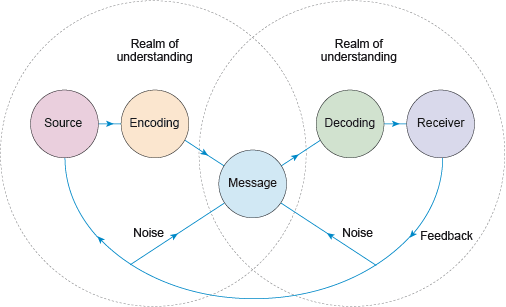
Many theorists have defined communication throughout the years but for the sake of clarity, we’ll use the definition proposed by Miller (1966). According to him, it has as its central interest those behavioral situations in which a source transmits a message to receiver(s) with conscious intent to affect the latter’s behavior.

According to the book Human Communication (2006), there are 6 stages within the communicative process.

  1. Naturally, any communicative act begins with a sender who decides to initiate a message which expresses a specific set of intended meanings.
  2. The sender encodes or creates the intended meanings by selecting specific words and gestures which have conventional meanings presumed to be understood by the receiver
  3. The message is transmitted; this message may be spoken or written so as to cross the space between the sender and receiver as a signal of patterned information.
  4. The receiver perceives the incoming patterned information, identifying it as a specific language.
  5. The receiver then decodes or interprets the message by constructing his/her own understanding of the conventionalized meanings of the symbols
  6. The mere fact that the receiver is interpreting the message; he or she will be influenced in some way which can range from trivial to profound.

Here is a visual representation of the process

photo credit- Google images


It is worth mentioning that this model is basic; it assumes that during an interaction the roles are static and there aren’t any interferences. FAR FROM THE TRUTH.  During an interaction the sender and the receiver may switch roles frequently and the transmission of the message may be affected by environmental factors such as noise in the physical environment or anything psychological such as perceptions.

But how do we know if our messages are being received or interpreted accurately?FEEDBACK.  This allows us to know whether we are getting through to someone. Feedback may be verbal or nonverbal. For instance, if I am talking to my lecturer and she begins to frown or shrug her shoulders, I know that it is highly probable that she doesn’t understand me. This cue prompts us to change or restructure our messages

Now, let’s turn our attention to another way in which meanings may be produced.

Representation

photo credit- Google images


I bet you weren’t aware that the word represent can actually have 3 different meanings.

  1. To stand for, as in the case of a country’s flag which when flown at any international event, signals the country’s presence at that event
  2. To speak on behalf of, like a spokesperson. Take the pope for instance, it can be said that he represents the Roman Catholic community
  3. The third takes the sense of presenting a historical fact in a contemporary time. As such represent is seen as RE- present.

Representations are only meaningful within discourse; that being statements, images, practices and institutions which represent a body of knowledge. This is because these represent a set of shared conventions based on a common experience. For example, representations of mother and child in western art, advertising and newspapers usually portray women as nurturers. This is one element of the system of representation that constructs women primarily as mothers. The message here is that a woman’s worth is tied to her motherly qualities.

It must be noted that they are purposefully constructed often for exploitative purposes and power. We see this with the Europeans back in the days of slavery. In order for one area of the world to colonise another, the colonisers must represent the world in a particular way. The British imperialists understood Africa to be an uncivilised place, filled with primitive people. Whereas Europe represented enlightenment and reason; this knowledge endorsed the practice of slavery.

As I’m sure you all can see now how meanings can be manipulated as well as misinterpreted. What may conjure one image to you may conjure another image for another. In spite of different individual perspectives, there are still experiences which may unite us based on commonality. These representations are less likely to change.

Carnival as a powerful festival for the Caribbean

photo credit- Google Images

What is Carnival?

You mean dressing in skimpy costumes and gain wukking up in de road? Well not quite, I bet you will be amazed to know that Carnival has had many factors in its history which have led to it being the colourful celebration that it is today. It has roots in colonialism as it was brought by the colonial superpowers, religious conversion in the fact that it started out as a Christian festival and freedom and celebration as the slaves used it to observe the end of slavery. In fact, the word Carnival is made up of two Latin words, “carne”, meaning flesh and “vale”meaning farewell and it commemorated a time where persons lived life to the fullest before the Lenten season. This is because during the Lenten season one is supposed to practice abstinence. Carnival usually consists of dressing in masquerade, music and dancing.

Example of Carnival in the Caribbean (Martinique)

photo credit- Google Images

In Martinique, carnival consists of five days of festivities (Samedi Gras, Dimanche Gras, Lundi Gras, Mardi Gras and Ash Wednesday). Each day has a specific theme, on Saturday and Sunday there is the presentation of the King Vaval as head of the cortege. On this day there is also no dress code; everyone dresses as they please. Monday is the day of burlesque weddings in which gender roles are reversed; the man dresses as the bride while the woman dresses as the groom. Tuesday marks Mardi Gras which begins with a very early parade at around 4:30 am called ‘pyjama lévé’. Everyone in its path is invited to wake the other inhabitants of the town wearing their pyjamas. There is an evening parade in which everyone is dressed in red and black representing the devil. Ash Wednesday is the day of mourning; everyone is dressed in black and white for the death of Vaval who is burnt on a bonfire at midnight bringing Carnival to an end.

What was the purpose of Carnival?

Nowadays you may see Carnival being used as a means of entertainment and while it is true that entertainment is in part one of its purposes, there are much deeper causes for Carnival. Carnivals were a way for Caribbean people to express themselves through their bodies. The body is central to artistic expression in African and Indigenous cultures and within a colonised setting, the body was the only thing left for the Africans, indigenous people and people of colour; therefore, carnival was a perfect way to manifest the various art forms and cultural expressions. Body paint and different types of nudity were all forms of expression significant to colonial people and they were not just about ‘wutlessness’.

Case in point with Martinique, the Vaval is a giant puppet representing a public institution or figure or a politician. The “Neg-gwo-siwo” is a character symbolising the slaves. This character is covered with a mixture of sugar cane syrup and crushed coal which is symbolic of the maroons. So if someone were to ask me, what does this all mean? I would say for me, Carnival constitutes a means of fusing the past with the present. By this I mean that this stage allows us to collectively commemorate how far we have come as a people i.e severing ties with our colonial masters’ traditions and to campaign for political and social reform .

When slavery was abolished in the late 19th century, Carnival was then a celebration for the end of slavery and within these celebrations, the antics of the slave masters were mocked and the evils of slavery were at the forefront of the exhibition. So, here we are celebrating something that was denied to us. It’s like “look at us now, we’re free and mocking you and there is nothing that you can do about it. Carnivals were instruments for social and political advocacy. The songs played during the festivities as well as the slogans were subtle ways to broadcast political statements.

Takeaway

Next time you watch Carnival on TV or live in person; remember there are deeper meanings behind it. Though Carnival was of European origin, slaves created a new version by using it as a framework and adding their flavour to it. Essentially, Carnival was and continues to be one of the ways in which we ridicule our former owners and it serves as a cultural platform which allows Caribbean persons to express themselves artistically.

How does Globalisation negatively impact on Caribbean Culture?


photo credit- Google Images

What is Globalisation and Culture?

Globalisation is a very broad concept and may be analysed from various aspects but according to Ritzer and Malone (2001), globalisation refers to the transnational flow of people, financial resources, goods, information and culture. Culture can be simply defined as a way of life of a group of people or a society; it includes but is not limited to language, religion and values.

Is this process helping or harming Caribbean culture?

Well first of all technology has the ability to remove geographic boundaries thereby making communication far easier as well as faster. Therefore, persons in remote places may receive some insight into Caribbean culture. For instance, Dr. Deborah Hickling, lecturer in Cultural studies at UWI Mona noted that within a small village in West Africa called Kokrobite there was a cultural centre in honour of ‘King yellow man’ who is a Jamaican dancehall and reggae performer. In spite of this, I believe globalisation is doing far more harm than good to Caribbean culture.

What are these negative impacts?


Photo credit- Google Images

Well, it has created a situation of cultural imperialism whereby Western cultures have begun to infiltrate local cultures leading to cultural erasure. This can be readily seen throughout the region with some territories adopting Halloween and Black Friday both of which are North American traditions. As far as I am concerned, these have nothing do with the Caribbean; they are neither rooted in Caribbean history nor do they in any way represent it. Moreover, most of the televised channels in Caribbean households are of the global north and this is one of the prime mediums by which music, ideas and fashion are imposed on Caribbean people. It is worth highlighting that the audience which will most likely be impacted the strongest will be the youth due to their high impressionability and they are the ones who are the future and will be responsible for cultural transmission to future generations.

This means that our children will grow up with a liking for products of the global north and not the Caribbean which is where their roots will be. For example, one day I was surfing the web and I stumbled across a Trinidadian blog which addressed the effects of globalisation. What was unsettling was that the writer recalled an incident where she caught her young cousin speaking with an American accent and when she asked his parents why he was speaking like that; they simply replied that it was as a result of the Disney channel shows that he was watching. This is an example of how America is slowly establishing its ways into the Caribbean.


Photo credit- Google Images

Another aspect of Caribbean culture heavily impacted by globalisation is language. English is the modern lingua franca of the world and as a result Creole languages or nonstandard varieties are marginalised. It is a common misconception that within the Anglophone Caribbean that English is the mother tongue of the children. Therefore when English is being taught in primary schools; it is being taught as a first language so that in many cases there is no formal recognition of the local vernaculars. This is the reason why so many children have such a hard time grasping the English language because it is actually not their native language. Although many linguists and academics have pointed to the merits of creole as an instructional tool, there still remains a stigma attached to its usage within any context which is in large part the fault of globalisation as it only encourages the learning of languages with universal appeal. Hubert Devonish, professor of linguistics at UWI Mona Campus states that Creoles are integral to the Caribbean as they are a symbol of its hybrid culture and they are authentic expressions of Caribbean nations’ identities.

Although I understand that the world is changing, we still must not give up who we are to conform to the world because in my view our uniqueness as a region and as a people is what we thrive on.


Is there a Single Caribbean Identity?

What is the Caribbean?

Defining the Caribbean as an entity poses difficulties as it is often viewed from different perspectives. For example, Anglophones in the Caribbean usually think it consists of the English speaking islands or CARICOM. While this contrast in perspective has given rise to varied definitions, there is still one effective way to define the Caribbean and that in my view is a zone which is not necessarily geographically bound but can be extended to remote places. In other words, I believe culture constitutes the best means to define the Caribbean and therefore I must agree with some scholars’ viewpoint that the region may be defined as a socio-historical category referring to the cultural zone that is characterised by the legacy of slavery and the plantation system. This definition stretches to include the islands, mainland territories and even the Caribbean diaspora overseas.

What is Caribbean Identity and how is it expressed?

Naturally, there is an equal amount of ambivalence regarding Caribbean identity. This is due to the high amount of diversity which exists. An identity may be defined as the individual characteristics, style or manner that is fundamental to the person and by which that person is recognised. Caribbean identity is represented most notably through the cultural aspects of religion, language and food. While Christianity may be the most practiced religion in the region, there is also Hinduism, Islam and varieties derived from Shango. There are six official languages: French, Spanish, English, Dutch, Haitian Creole and Papiamentu as well as thousands of local vernaculars and creoles spoken throughout. Callaloo is a popular Caribbean dish though it may vary from island to island and has indigenous, African and European influence.

How are Caribbean identities constructed?

In my opinion, Caribbean identity which is based on culture is formed through the following processes:

Cultural diffusion– when a culture comes into contact with others, there can be borrowing of cultural traits from one another and these borrowed traits are spread throughout each society. Caribbean diaspora represents a clear example of cultural diffusion in the celebrations of Caribana and Labor day carnival.

Acculturation– when two cultures have continuous first hand contact with each other, the exchange of culture is known as acculturation. This occurs when one culture has been colonised or conquered by another. Language provides an example whereby Pidgins emerged from African and British interaction but the end result are creole languages which are natively spoken all over the Caribbean.

Cultural hybridisation- refers to the processes of cultural and ethnic mixing to produce new forms. In the Caribbean context, it describes the fusion between different races to produce hybrid people. Religions such Rastafarianism in Jamaica and Shouter Baptist in Trinidad are examples of cultural hybridisation.

So is there a single Caribbean identity?

In spite of the presence of different Caribbean identities, there are still common elements across these plural Caribbean societies. These elements I believe make it appropriate to still believe in the notion of a single Caribbean identity at least from a historic standpoint. No matter what Caribbean people do or create, a common historical legacy of slavery and colonialism and a common inheritance of norms and values ​​of plantation society which is observed in cultural plurality and social stratification are grounds on which the Caribbean can and will still be identified as a single entity.

photo credit- Google Images